Democracy by Design Conference
The Brown/Yestermorrow Bench Project
.png)
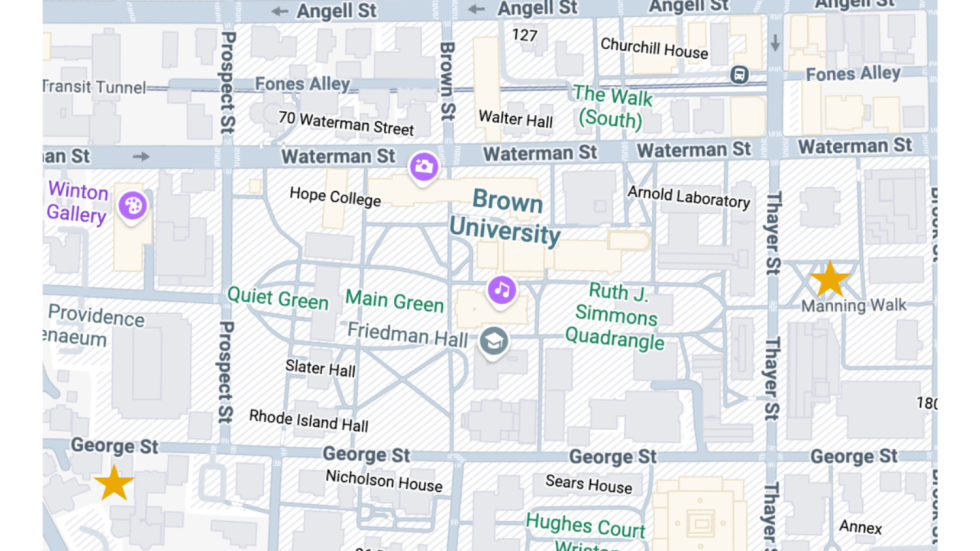
“Democracy by Design” was the year-long focus of the Democracy Project’s “Varieties of Democratic Experience” in 2025-6. As part of that focus, scholars and faculty from several departments at Brown, Smith, Vanderbilt, NYU Gallatin, and the University of West Washington met in December 2025 at the Yestermorrow School of Design/Build in Vermont where we were challenged to imagine what a democratic bench should be. “Deep,” is one answer, since (i)democracies need deep benches of leadership so that others are always able to step up when needed, and (ii)deep thinking is a must, too, since there are no quick and easy answers to the questions of how to imagine, plan, and build our collective futures. At Yestermorrow, we all learned to use power tools and we designed protoypes that emblematized refuge, rest, reflection, encounter, and cooperation. At the April 2026 international conference, Democracy by Design, those who took part in the Yestermorrow Bench Project shared their sense of the experience. Here are some photos of the participants and their benches and a map of where to find all three benches on campus. The benches willbe at Brown until Nov. 2026. (Let us know if you’d like to adopt-a-bench!)
This planned conference, hosted by the Democracy Project’s “Varieties of Democratic Experience” stream led by Bonnie Honig, is co-hosted by Honig (Brown) with Emily Norton, Founding Director of the Design Thinking Initiative at Smith College, and collaboratively imagined with Juliet Hooker (Brown), Deva Woodly (Brown), and Shatema Threadcraft (Vanderbilt).
The rationale for this conference is to explore what democratic theorists might have to learn from the design justice movement and the field of Design Studies. How might design/build perspectives inform plans and ideas for democratic futures? The question is important now, in particular, because no return to old party politics seems tenable and options for building anew may be more open than in recent decades.
In keeping with Brown 2026’s mission to consider “the history and legacies of the American Revolution,” the conference takes one of its points of orientation from Alexis de Tocqueville, whose Democracy in America, Vol.1, shows the European aristocrat’s appreciation in the American context of the power of democracy to unleash great social energies that trend toward equality. In Vol. 2, however, that celebrated dynamism of American life strikes Tocqueville as a worrying and damaging restlessness. Where, in Vol. 1, Tocqueville is impressed by a New World equality that allows gentlemen and laborers to nod to each other in the street, in Volume 2, such emergent egalitarianism is replaced by an entrepreneurial penchant for movement that leads a man who has just built a roof for his new house to abandon the dwelling in order to seek out other opportunities elsewhere. These two of Tocqueville’s examples are urban and rural, one is in a space of encounter, the other, one of isolation. That is, both examples are marked by their location, space, and design. Inspired by Tocqueville, we ask: which infrastructures, relationalities, and settings can harness the dynamism he celebrated in Vol. 1, while limiting the trend to anomie described in Vol. 2?
Democracy By Design is also oriented by now-familiar political flashpoints: The maintenance or disposal of Civil War statues/monuments, binary gender-specifying public bathrooms, redistricting practices and immigration politics. These political issues are part of an emerging effort to (re)design US political structures and norms. Our focus is not on the negative, exclusionary politics associated with these issues, nor on the de-democratizing agendas that may drive them, but on what drives it all: an aspirational re-imagining of public memory, resource distribution, civic practices, and shared spaces. We ask: what infrastructural re-designs might instead fortify a more democratic orientation? Can design help neutralize current conflicts or reorient public discussion of divisive issues in ways that advance equality? Can design studies, partnered with the social sciences, law, and humanities, advance more inclusive and involved practices of citizenship? The U.S. Constitution is one such design, of course: this is why it is often called a blueprint. Other plans and architectures might support a democratic redesign now: alternative bathroom design (single stalls. shared sinks, open access?) can dampen the fanned flames of so-called single sex ‘safety.’ Alternatively, design can also ennoble the equality we seek, as is the case with the encaustic tiles used in NYC’s Central Park: the tiles’ design is baked in, not painted on the surface. This means that, over time, even when they are worn from use or exposure, the design remains. We find in these tiles a lesson in constitutionalism to meet the moment.
If democracy, now increasingly throttled, needs funneling, how should the funnels be shaped, by whom should they be built, out of what materials, and how? How can we support new, emergent energies and push them in increasingly democratic directions? What modes of organizing and which contributions to theory build on the best exemplary experiences in refusal and self-governance?
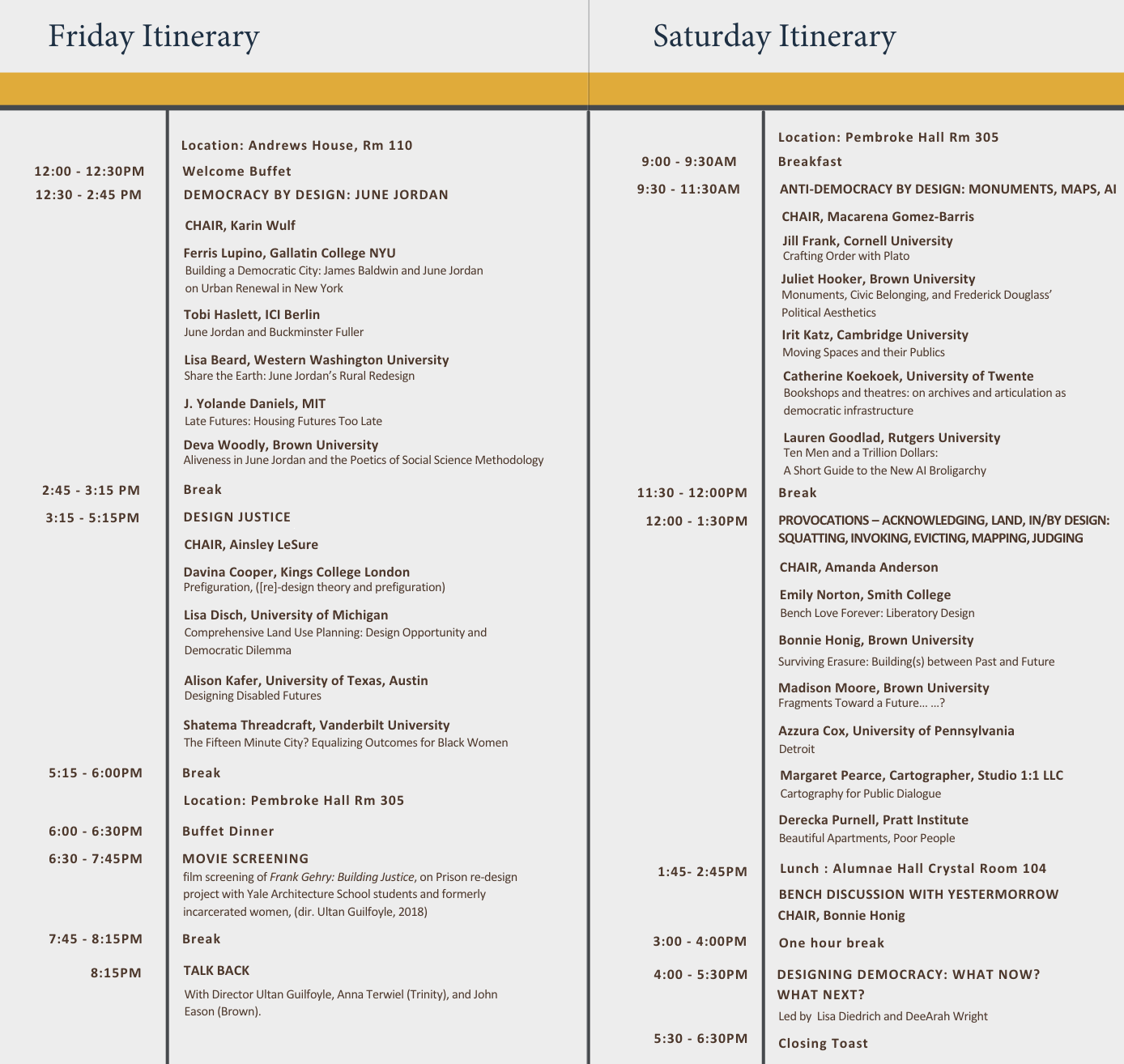
Held on April 3-4th 2026, the Democracy by Design Conference at Brown University, Providence opens with a panel on June Jordan’s work with Buckminster Fuller and her futuristic “Skyrise for Harlem” project. Over the next day and half, drawing on the archives and approaches of several disciplines, we will center other such efforts, the obstacles faced, the imagined and imaginable possibilities that remain, what work currently in play seems promising, and where there is reason to hope.
We thank both the Salomon Fund and Brown 2026 for their generous support.
Tentative Schedule: